

How to Stay Focused While Studying: 15, 25 or 45 Minutes?
No research settles the best length for a study session. Two small studies of university students found that timed breaks and self-chosen breaks got similar amounts of work done, and we found no study of secondary-school students. Treat 15, 25 and 45 minutes as options: pick by the task and by how you feel today.

Published · Updated · 6 min read
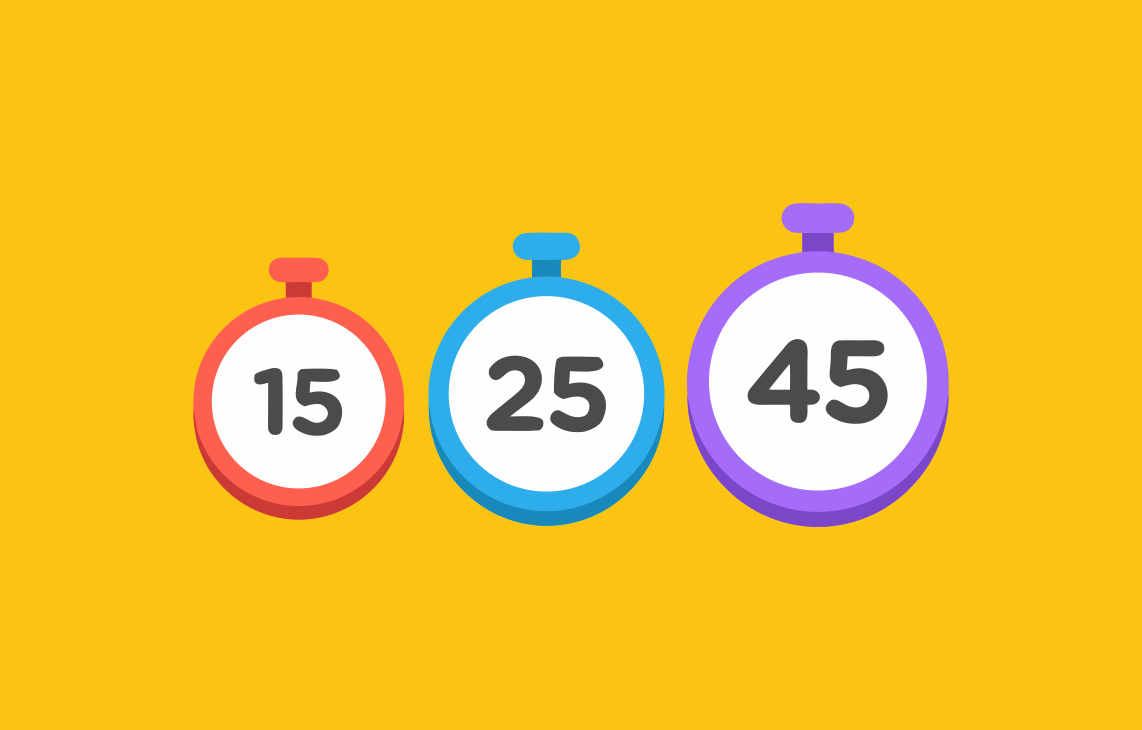
How long should a study session be?
Long enough to get somewhere on one task, and short enough that you are still working when it ends. No research gives a number that fits everyone, and we found no study that tested session lengths with secondary-school students.
Below are three lengths to try, 15, 25 and 45 minutes, and a way to choose. None has been shown to be the right one.
If the work is still in your backpack and you have not begun, the problem is starting. Read How to Start Studying When You Just Can't Get Started first.
Is 25 minutes the best length?
Nobody has shown that it is. You have probably met the number through the Pomodoro method, 25 minutes of work and 5 of rest, and the research on it is small and mixed.
In 2023, researchers in the Netherlands studied 87 university students during one day of self-study. Some took breaks on a fixed schedule (24 minutes of work then 6 of rest, or 12 then 3). The others took a break whenever they chose. The groups finished similar amounts of work. Those who chose their own breaks studied in longer stretches and reported feeling more tired and more distracted.
In 2025, a study of 94 university students over one two-hour session found that tiredness built up faster on the 25-and-5 schedule than with self-chosen breaks, though overall tiredness did not differ. Again, the groups got similar amounts done.
So the fixed schedule felt better in one study and worse in the other, and neither time did it change how much got done. Both studied university students, and neither tested 15 or 45 minutes.
When should I pick 15, 25 or 45 minutes?
Pick by the task in front of you and by how you feel today. A short session is easier to begin, and a long one leaves room for work that takes a while to get into.
| Session length | Good for | Watch out for |
|---|---|---|
| 15 minutes | Getting going when you don't feel like it. A small, clear task: ten vocabulary words, five math problems. | It can end just as you get into the work. If so, run a second one. |
| 25 minutes | Most everyday homework: a chapter to read, a problem set. | The timer ringing mid-problem. Finish the line you are on, then stop. |
| 45 minutes | Work that needs a run-up: an essay, a practice test. | Drifting in the last third. If it happens twice, drop to 25 next time. |
The table is a starting point and not a research finding. Use one length for a few days on the same kind of work. Keep it if you are usually still working when the timer ends. Go shorter if you keep checking how much time is left.
These are also the three preset lengths on the Alta Ipsum focus timer, which also takes a length you set (see The focus timer), and there too they are options.
How long should I study before taking a break?
Decide before you start, and take the break when you reach it. The two studies above did not find a best interval, so the gain is practical: you are not arguing with yourself in the middle of a math problem.
About 5 minutes after a 15 or 25 minute session, and about 10 after 45, is a reasonable place to begin. In a real break you leave the work: stand up, drink some water, look out of the window. Keep your phone out of it if you can. A feed has no end, and your break does.
How do I stop getting distracted while studying?
Set the session up before it starts, so there is less to resist once you are working. It takes about two minutes.
- Choose one task and write it down: "history, chapter 4, questions 1 to 6".
- Put your phone out of reach with the sound off, in another room or in your backpack. If your timer is on your phone, silence notifications and leave it face down on the far side of the desk.
- Set a timer for 15, 25 or 45 minutes. A kitchen timer, a watch or the focus timer in Alta Ipsum all do the job.
- When it rings, take a real break away from the desk.
- Before you get up, write one line saying where you stopped and what comes next.
The last step is the one people skip. A note such as "question 4, still need the date of the treaty" lets the next session begin in seconds.
What do I do when I lose focus halfway through?
Go back to the task you wrote down and do the smallest next piece of it. Drifting in the middle of a session is ordinary, and the session is still worth finishing.
Read your line from step 1 again. Then do one small thing: one sentence, one problem, one paragraph read out loud. If the phone is in your hand, put it back where it was.
If you drift three times in one session, stop the timer, take your break early and start again with 15 minutes.
For the last stretch of an assignment, see How to Finish Homework on Time (and Actually Turn It In). Executive Function in Teens: A Plain-Language Parent Guide shows where staying focused sits among the skills behind schoolwork.
What if focus is hard everywhere, all the time?
Then a timer is only part of the answer, and it is worth telling someone. If you cannot stay with things in most classes, at home and even in things you enjoy, and it has been that way for a long time, talk to an adult you trust: a parent, a teacher, a school counselor or your doctor. They can help you work out what is going on. An article cannot tell you why it is happening.
Questions people ask
Sources
- Biwer, F., Wiradhany, W., oude Egbrink, M. G. A., & de Bruin, A. B. H. (2023). Understanding effort regulation: Comparing "Pomodoro" breaks and self-regulated breaks. British Journal of Educational Psychology, 93(S2), 353–367. doi:10.1111/bjep.12593. https://europepmc.org/article/MED/36859717 (added by writer, verified: abstract)
- Smits, E. J. C., Wenzel, N., & de Bruin, A. (2025). Investigating the effectiveness of self-regulated, Pomodoro, and Flowtime break-taking techniques among students. Behavioral Sciences, 15(7), 861. doi:10.3390/bs15070861. https://pmc.ncbi.nlm.nih.gov/articles/PMC12292963/ (added by writer, verified: full text)